

🌍 Public RSVP
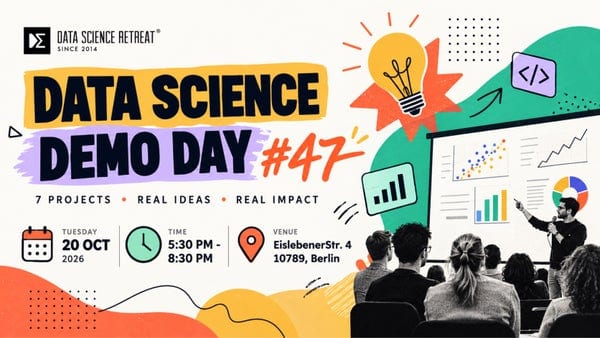
Data Science Retreat Demo Day #47
When
Today · Tuesday, 20 October 2026
17:30–20:30
“Interested” saves it to your list and sharpens your recommendations. “Going” marks your spot and opens the organizer’s page so you can grab the actual ticket.
**Hey Berlin Data Folks!** We’re looking forward to welcoming you to our next **Data Science Demo Day on 20th October**. Our **Batch 47 participants** have been busy working on their final projects, and they’re ready to share what they’ve built. This time, we have **7 projects** covering a pretty wide mix of topics, from groundwater exploration and healthcare to career transitions, engineering, agriculture, fire detection, and even fermentation. It’ll be a relaxed autumn evening to see some practical data science and AI applications, meet others from Berlin’s data community, and chat about ideas, projects, and what people are working on. And, of course, we’ll have some pizza and drinks to keep everyone going. **Free to Attend!** **Agenda:** **17:30** \- Drinks and Networking **18:00** \- Welcome & Introduction Followed by Project Presentations **Project Ideas:** **1\. DeepWell \- Machine learning for predictive groundwater mapping** ***Project by Sascha Alexeyenko*** Finding reliable groundwater is a major challenge in regions where water is scarce, and drilling a borehole can be expensive without any guarantee of success. DeepWell explores how machine learning can help identify promising locations for groundwater drilling. By combining historical borehole records, including unsuccessful attempts, with geological, terrain, and climate data, the project aims to predict the likelihood of finding water with sufficient yield and quality. The initial focus is on Kenya, particularly Turkana and Marsabit counties, where access to reliable water remains a challenge. The goal is to help make drilling decisions more informed, reduce unsuccessful attempts, and support better groundwater planning. **2\. Personalized Psychiatric Treatment Selection for Depression** ***Project by Aleksandra Garifulina*** Finding the right antidepressant treatment can be a very individual process. This project explores whether machine learning can help support more personalized treatment selection using patient-level clinical characteristics and treatment-response data. The project looks at supervised classification methods to match treatments more closely to individual patient profiles. It also explores how clinical guidelines, treatment suitability, and contraindications could be incorporated into the process. The goal is to investigate how these tools could support clinical decision-making rather than replace it. **3\. Job Transition Workspace** ***Project by Timothy LeBon*** Changing careers can mean juggling job searches, applications, skills, resumes, advice, and a lot of uncertainty all at once. This project brings those pieces together in one intelligent career transition workspace. Using data from O\*NET, the U.S. Current Population Survey, and the Anthropic Economic Index, the system recommends roles based on a person’s skills, experience, career goals, and job-market demand. It also includes an LLM workspace that can work with resumes, chats, and cover letters, along with tools for things like job searches, email, reminders, and calendar management. The goal is to create one place where people can plan and manage a career change with more personalized, data-informed support. **4\. AI\-Assisted Requirement Change Impact Analysis** ***Project by Lakshmi Swetha Pasupuleti*** In complex engineering projects, changing one requirement can affect many other things, from software requirements and design decisions to test cases. This project looks at how AI can help engineers understand those connections, especially when they are not already documented. The idea is to use semantic analysis to find related engineering artifacts and, importantly, explain why they might be affected by a change. The project will compare AI-based methods with more traditional traceability approaches across different change scenarios. The end goal is a lightweight prototype that explores where AI can make requirement change analysis easier and more useful for engineers.
Who's going
Speakers from
- Where
- Data Science Retreat, Berlin
- Who's behind it
- Data Science Retreat (Meetup)
- Who's going
- ~47 expected
- Registration
- 🌍 Open to all
More events like this
Same scene, around the same time.



Contracts signed in minutes — on your own domain
wesign.now — the European alternative to DocuSign and DocSend, in one Swiss tool. Free plan: 10 documents a month, no credit card.
Start for free